For my physics term
paper, I chose to study Howl’s Moving Castle, a 2004 traditional hand-drawn
animated film directed by Hayao Miyazaki from Studio Ghibli, a Japanese
animation studio famous around the world for their unique and beautiful films.
The story follows a plain young woman named Sophie, whose dull life is upended
when she is cursed by a witch, and she seeks out the wizard Howl for help. Over
the course of the film she becomes a cleaning lady for a wizard, befriends a
fire demon, finds herself, finds a family, and finds love. I chose this film because it is part of a
great collection of films, and it is a less exaggerated movie (no outrageous
squash and stretch or zany timing), unlike its western counterparts, and like many Ghibli
films, is rooted very firmly in a world that resembles our own, where the
humans move like we do, and adheres to physics like ours while also containing
magic that lets characters defy these laws at the same time, at any moment. This
sensibility of following physical laws until there is a reason to break them
punctuates the sense of magic in the world of the film.
In many Ghibli
films, flight is a major theme, and ‘Castle’ is no exception; within the movie
many characters and objects defy gravity in contrast to more human characters.
At the very start of the movie, our heroine Sophie encounters Howl, who rescues
her from a pair of guards and other enemies by lifting off into the air above
the town building and floating over rooftops with no outside assistance or
force behind the action (figure. 1), and throughout the movie Howl is seen flying or
levitating like this. There are also many flying machines and aircrafts
throughout the film, all constructed in such a way that their mass and shape,
as well as their small fluttering wings (figure. 2), do not support their ability to fly as
physics would allow it; this goes for both the huge and heavy bomber warships,
and the smaller personal craft Howl pilots while visiting the king. They are
aerodynamic in a hypothetical sense only. The dog Heen also uses his long ears
to glide over the ground when he needs to move faster than his short legs
allow. In contrast to these more fantastic elements, Sophie is often the unlucky
receiver of the effects of gravity (she is frequently thrown around, carried,
or crashes into things while Howl is afforded more grace via his powers), as is
the Witch of the Wastes, who succumbs the a more unflattering and subtle form
of gravity when her powers are stolen, and her magic can’t help her from
showing her true age.

Fig. 1 Howl and Sophie

Fig. 2 Flying machine
In this world, most
characters experience inertia and overlapping action (like hair and clothes and
limbs following the body in motion and continuing in that motion), law of
acceleration and motion, but certain occasions of drama cause characters to break
the rules. In one scene, Howl is protecting Sophie’s house from enemy bombs,
and as one hurtles toward the ground, he chases after it, and seconds later
overcomes it (and stops it from detonating), despite its mass and acceleration
being greater than he is, and having air resistance working against him. The
bombs terminal velocity is greater than Howls; it’s physically impossible that
he would have caught up. In an instance that both follows and breaks laws, Howl
carries Sophie to safety and lets her go to fly into the door back home. Her
path of action, instead of falling straight down, sends her falling
horizontally in an arc at the door, but normal physics kicks in again when her
motion is stopped by crashing into stairs, the stairs being the unbalanced
force. In another moment, Howl and Sophie are escaping the witch Suliman, and
shoot through a glass roof into the sky, only to change direction without being
effected by gravity or an opposing force.
In ‘Castle’, many
structures and characters defy physical believability in how they are put
together with the aid of magic. The biggest example of this is the moving
castle itself, which is a hodgepodge of metal and wood and brick seemingly
thrown together on stilt-like clawed metal legs (figure. 3). Nothing appears to fit
together in any discernible way, and the legs are too thin to support its
weight or its ungainly way of moving. Similarly, the character Turniphead, a
sentient scarecrow Sophie encounters and befriends in the wastes, is constructed
from a pair of sticks and a turnip, wearing and old suit (figure. 4). He moves primarily by
bouncing around on the end of his stick, sometimes at great heights, and, like
the castle, would not be able to actually stay together without the aid of
magical forces, as physical laws mean he would fall apart. Certain living
characters challenge believability as well, most notably the Witch of the
Waste, a hulking woman whose sheer size, shape and weight would crumble quickly
(or at least not last long) due to our physics, much like individuals with
gigantism.

Fig. 3 The Moving Castle
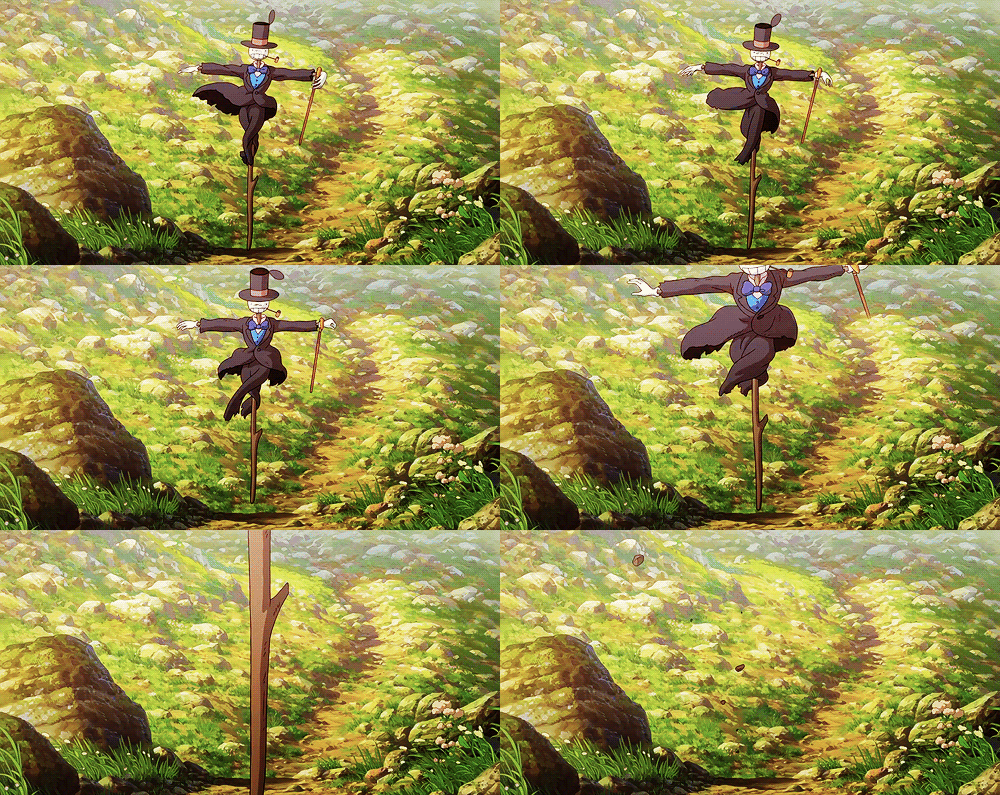
Fig. 4 Turniphead
In the end, there could be so much more to cover about the
movie, but what remains is more magic than physics (the changing doorway, Howl
transforming into a bird and back, Sophie’s shifting between young and old age, etc.), and requires suspension of
disbelief, yet doesn't pull you out of the movie. Howl’s Moving Castle is a
beautiful film, a work of pure artistry from Studio Ghibli. It’s full of
beautiful and colorful environments and characters that draw you in. To conclude, in this film, Howl and Sophie’s
world feel similar to ours, the laws of physics followed the same way as ours,
until they are broken on the whim of magical occurrence. This contrast is used
at the most important story points of the film, and not overdone to create a
sense of wonder, and we experience that wonder with Sophie as she does. The
film lets you immerse yourself in that way, and I certainly am every time I
watch it.

No comments:
Post a Comment