Sunday, December 8, 2013
Friday, November 29, 2013
Wednesday, November 20, 2013
Tuesday, November 12, 2013
Third Term Paper
My first two term paper scores were 95 and 85; I will not be writing a third term paper.
Thursday, November 7, 2013
Outline for Third Term Paper
- Introductiona. Evolution of VFX through the decades, from blue screen to matte painting and CGIb. Introduce specific effect, snow. Practical effects replaced by VFX in current film, tv and gaming.c. For this paper I will discuss two pieces of media and the snow effects in them:1.Film, Monsters Inc2.Videogame, Journey
- Body1. Monsters Inca. Set up film, context: Mike and Sully are exiled into the Alps in the middle of a snowstorm.b. Snow effect created in programs such as AfterEffects, Maya, and 3DS Max with a particle system or particle tracking technique. Discuss animated particle systems.c. Effectiveness very good, combination of wind and sleeting effect with movement of Sully's fur drives point home, takes on very realistic quality.
2.
Journey
a.
Set up video game, context: The Protagonist is scaling the Mountain
through the snow.
b.
Snow effects created in programs like AfterEffects, Maya, 3DS Max
with particle system or particle tracking. Discuss static particle systems.
c.
Effectiveness so so, creates feeling of snow but with less realism
than Monsters Inc, meant mostly just lend to atmosphere
to remind player its snowy, snow sometimes looks less individual and
looks more like clouds. Snow is at its most basic and atmospheric.
III. Conclusion
a. Recap evolution of VFX, practical effects all but dead.
b. Snow and other weather effects all done in CG.
Saturday, November 2, 2013
Character Animation
This assignment was actually lots of fun! I'm used to/enjoy best drawn animation and have never done stop motion, so this was a little intimidating. I started off with my idea, which I had swimming around in my head for awhile, and planned it all out on paper to figure out where my timing would be, and then set up a friends downshooter and worked for hours, breaking up each part and making sure I was happy with it before I moved on (I broke the action into 3 parts, the swimming, the squash, and the flower vase transformation). The music was a happy accident, as the song came on when I was animating.
Tuesday, October 22, 2013
Science Fact or Cinematic Fiction
Newton's Third Law in Animated Films
Ever
since the early days of film, animation has allowed filmmakers to
stretch the laws of physics to their hearts desire. They can create
characters that can't exist, situations that can't happen, actions
that defy the limits and abilities of the human body, all for our
entertainment. For these movies to be believable and relatable,
however, they need to be rooted in recognizable physics so the
audience feels a sense of familiarity with the film, or they can be
taken out of the experience. Newton's Third Law, which states that
every action has an equal and opposite reaction, its constantly bent
and broken or flat-out ignored for effect in movies, to huge or
subtle effect. For my paper, I chose to examine the films The
Croods, Princess Mononoke, and The Incredibles and
how the 3rd
Law is treated in them.
My first
example of a false portrayal of Newton's 3rd Law is from
“The Croods”. The film is a computer animated movie produced by
Dreamworks Animation, released in 2013 and written and directed by
Chris Sanders and Kirk DeMicco. The film is a colorful comedy set in
a fictional prehistoric world populated with wild beasts and fearful
cavemen, threatened by a brainy new traveler who challenges and
changes their way of life as they search for a new place to live. The
films universe is (very) loosely based on our own, and the distortion
of physics in this films is used primarily for comedic effect and to
heighten the action. The film breaks Newtons Third Law often, and the
example I chose is the "log kick" scene.
The scene occurs
about halfway through the movie, where Grug and Guy are negotiating
Guys continued presence and aid on their journey, which entails: no
more trapping Guy in the log, and it ends with Grug kicking away the
log at Guys command. The scene escalates when Grugs kick sends the
log flying miles away, with only the effort and force of a average
soccer kick. Now, it is set up early on that the family of cavemen
are stronger than average, but it is also established that Guy has
strength more similar to the average human. Newtons 3rd
Law states that every action has an equal and opposite reaction. In
this case, the action is the kicking of the log, which would more
accurate if the kick were to cause very little motion in the log,
rather than hurling it with the power of a trebuchet, as well as more effect on Grug himself. This case of
ignoring the law by the filmmakers is, upon examination, an
intentional comedic punctuation mark to offset how “serious” the
standoff is, but even so, is impossible.
My second
example of a false portrayal of Newton's 3rd Law is from
Princess Mononoke, a traditionally animated film released in 1997
from Studio Ghibli and directed by Hayao Miyazaki. Set in Feudal
Japan, it follows the story of Ashitaka, a young man on a quest to
break a curse placed upon him, who gets caught up in a battle between
humans and animal spirits battling over the forest realm of the
Forest God. This film, like most Ghibli films, is set in a world that
is familiar to our own, with physics that resemble ours. My example
of where Newton's 3rd Law is broken occurs early on, after
Ashitaka is cursed, when he is riding by a village being raided. He
is pursued by the raiders himself, and he threatens them to keep
away; his curse has given him strength and powers that frighten him
and others.
(unable to acquire video)
He draws his bow and fires on one raider, and the arrow
severs the raiders head from his body. In this case, the action is
the draw of the bow, the opposite reaction being the force of the
release. In this example Ashitaka doesn't pull the bow with enough
force to even knock a rider from his horse, let alone sever their
head. A more accurate reaction would be for the rider to be struck,
and to slip and fall off their mount when their grip slackens, not
from the force of the arrows impact alone. This example of a clear
breaking of the 3rd Law was a conscious decision by the
filmmakers to increase the narrative impact of Ashitaka's curse; the
action is sudden and violent enough that it drives home to the
audience just how serious our protagonist's situation is.
My third
example of a false portrayal of Newtons 3rd Law is from
The Incredibles. One of Pixars early greats, The Incredibles is a 3D
animated film, written and directed by Brad Bird, about the secret
lives of a family of superheroes, whose abilities defy the laws of
physics simply by existing. My example is early in the film, when Bob
Parr (Mr. Incredible) becomes angry with his bosses constant jabs and
cruelty, until Bob finally snaps and punches him with such force he
is hurled through several walls.
This action is inconsistent and
unbalanced in several ways when related to the Third Law. The force
of the punch is great enough that walls are broken easily by a human
body, which is stopped only by metal cabinets, but all things
combined, do not kill the boss. If a punch from Mr. Incredible can
move a giant robot, surely an average person would be killed. In this
case the outcome of this action does not match up with what has been
established as a massively destructive force. In the context of the
story, this is a conscious decision that death is avoided so that the
levity of the movie is not lost, and Mr. Incredible is not made a
murderer in the first act.
The
Croods, Princess Mononoke, and The Incredibles demonstrate how
Newton's 3rd Law can be bent, broken, and in many cases
completely ignored in many animated films to the point where actions
can be so jarring it makes us, the audience, sit up and take notice,
or laugh harder for how ridiculous it may be.
Tuesday, October 15, 2013
Outline for Second Term Paper
1. Introduction
a. Establish genre, animation a style of film made for exaggeration.
b. Newton's 3rd Law of action/reaction broken nonstop in animation
c. List movies Princess Mononoke, The Croods, The Incredibles
2. Body
I. Princess Mononoke
a. Film description
b. How 3rd Law is treated within film, bent for narrative impact.
c. Example: Ashitaka exerts average force/pull on his bow, but the force of the arrows impact on its target severs their head.
II. The Croods
a. Film description
b. How 3rd Law is treated within film, bent for comedic effect.
c. Example: Grug kicks away the log with the force of an average soccer kick, but the log is propelled miles away.
III. The Incredibles
a. Film description
b. How 3rd Law is treated within film, bent deliberately to allow for superpowers.
c. Example: Mr. Incredible punches his boss through a wall, an act that would clearly kill any human in real life.
3. Conclusion
a. Establish genre, animation a style of film made for exaggeration.
b. Newton's 3rd Law of action/reaction broken nonstop in animation
c. List movies Princess Mononoke, The Croods, The Incredibles
2. Body
I. Princess Mononoke
a. Film description
b. How 3rd Law is treated within film, bent for narrative impact.
c. Example: Ashitaka exerts average force/pull on his bow, but the force of the arrows impact on its target severs their head.
II. The Croods
a. Film description
b. How 3rd Law is treated within film, bent for comedic effect.
c. Example: Grug kicks away the log with the force of an average soccer kick, but the log is propelled miles away.
III. The Incredibles
a. Film description
b. How 3rd Law is treated within film, bent deliberately to allow for superpowers.
c. Example: Mr. Incredible punches his boss through a wall, an act that would clearly kill any human in real life.
3. Conclusion
Tuesday, October 8, 2013
Tuesday, October 1, 2013
Stop Motion Animation of Falling
For my animation I decided to do a variation on the leaf drop, a (fake) flower blossom falling from a tree. The flower I used is from a decorative light I own. I filmed a little reference, but it wasn't what I was hoping for, and I instead turned to the internet to find instances of flowers falling more horizontally. I charted out my path of action on my living room wall, and taped the flower along my path of action and photographed each one. I then cleaned up all my frames in Photoshop and assembled them, removing frames for timing as need be. And here it is!
Sunday, September 22, 2013
The Laws of Physics in an Animated Universe
For my physics term
paper, I chose to study Howl’s Moving Castle, a 2004 traditional hand-drawn
animated film directed by Hayao Miyazaki from Studio Ghibli, a Japanese
animation studio famous around the world for their unique and beautiful films.
The story follows a plain young woman named Sophie, whose dull life is upended
when she is cursed by a witch, and she seeks out the wizard Howl for help. Over
the course of the film she becomes a cleaning lady for a wizard, befriends a
fire demon, finds herself, finds a family, and finds love. I chose this film because it is part of a
great collection of films, and it is a less exaggerated movie (no outrageous
squash and stretch or zany timing), unlike its western counterparts, and like many Ghibli
films, is rooted very firmly in a world that resembles our own, where the
humans move like we do, and adheres to physics like ours while also containing
magic that lets characters defy these laws at the same time, at any moment. This
sensibility of following physical laws until there is a reason to break them
punctuates the sense of magic in the world of the film.
In many Ghibli
films, flight is a major theme, and ‘Castle’ is no exception; within the movie
many characters and objects defy gravity in contrast to more human characters.
At the very start of the movie, our heroine Sophie encounters Howl, who rescues
her from a pair of guards and other enemies by lifting off into the air above
the town building and floating over rooftops with no outside assistance or
force behind the action (figure. 1), and throughout the movie Howl is seen flying or
levitating like this. There are also many flying machines and aircrafts
throughout the film, all constructed in such a way that their mass and shape,
as well as their small fluttering wings (figure. 2), do not support their ability to fly as
physics would allow it; this goes for both the huge and heavy bomber warships,
and the smaller personal craft Howl pilots while visiting the king. They are
aerodynamic in a hypothetical sense only. The dog Heen also uses his long ears
to glide over the ground when he needs to move faster than his short legs
allow. In contrast to these more fantastic elements, Sophie is often the unlucky
receiver of the effects of gravity (she is frequently thrown around, carried,
or crashes into things while Howl is afforded more grace via his powers), as is
the Witch of the Wastes, who succumbs the a more unflattering and subtle form
of gravity when her powers are stolen, and her magic can’t help her from
showing her true age.
Fig. 1 Howl and Sophie
Fig. 2 Flying machine
In this world, most
characters experience inertia and overlapping action (like hair and clothes and
limbs following the body in motion and continuing in that motion), law of
acceleration and motion, but certain occasions of drama cause characters to break
the rules. In one scene, Howl is protecting Sophie’s house from enemy bombs,
and as one hurtles toward the ground, he chases after it, and seconds later
overcomes it (and stops it from detonating), despite its mass and acceleration
being greater than he is, and having air resistance working against him. The
bombs terminal velocity is greater than Howls; it’s physically impossible that
he would have caught up. In an instance that both follows and breaks laws, Howl
carries Sophie to safety and lets her go to fly into the door back home. Her
path of action, instead of falling straight down, sends her falling
horizontally in an arc at the door, but normal physics kicks in again when her
motion is stopped by crashing into stairs, the stairs being the unbalanced
force. In another moment, Howl and Sophie are escaping the witch Suliman, and
shoot through a glass roof into the sky, only to change direction without being
effected by gravity or an opposing force.
In ‘Castle’, many
structures and characters defy physical believability in how they are put
together with the aid of magic. The biggest example of this is the moving
castle itself, which is a hodgepodge of metal and wood and brick seemingly
thrown together on stilt-like clawed metal legs (figure. 3). Nothing appears to fit
together in any discernible way, and the legs are too thin to support its
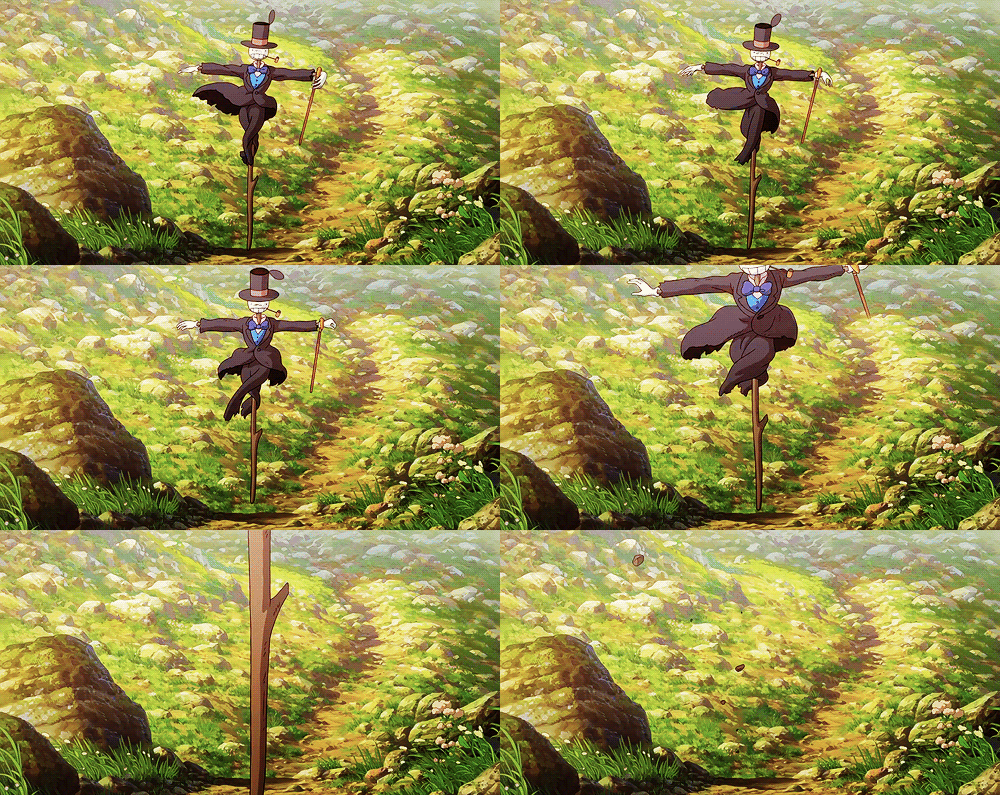
weight or its ungainly way of moving. Similarly, the character Turniphead, a
sentient scarecrow Sophie encounters and befriends in the wastes, is constructed
from a pair of sticks and a turnip, wearing and old suit (figure. 4). He moves primarily by
bouncing around on the end of his stick, sometimes at great heights, and, like
the castle, would not be able to actually stay together without the aid of
magical forces, as physical laws mean he would fall apart. Certain living
characters challenge believability as well, most notably the Witch of the
Waste, a hulking woman whose sheer size, shape and weight would crumble quickly
(or at least not last long) due to our physics, much like individuals with
gigantism.
Fig. 3 The Moving Castle
Fig. 4 Turniphead
In the end, there could be so much more to cover about the
movie, but what remains is more magic than physics (the changing doorway, Howl
transforming into a bird and back, Sophie’s shifting between young and old age, etc.), and requires suspension of
disbelief, yet doesn't pull you out of the movie. Howl’s Moving Castle is a
beautiful film, a work of pure artistry from Studio Ghibli. It’s full of
beautiful and colorful environments and characters that draw you in. To conclude, in this film, Howl and Sophie’s
world feel similar to ours, the laws of physics followed the same way as ours,
until they are broken on the whim of magical occurrence. This contrast is used
at the most important story points of the film, and not overdone to create a
sense of wonder, and we experience that wonder with Sophie as she does. The
film lets you immerse yourself in that way, and I certainly am every time I
watch it.
Monday, September 16, 2013
Term Paper Outline - Laws of Physics in "Howl's Moving Castle"
The Laws of Physics in Howl’s Moving Castle
I.
Introduction
a.
Introduce film “Howl’s Moving Castle”
b.
Traditional animation from Japanese Studio
Ghibli
c.
Hypothesis: Though the world of the film is
rooted in in ours, Howl’d world breaks and ignores many laws of physics while following
others, punctuating the sense of magic in the world.
II.
Body
A.
Gravity
0.
Numerous characters/objects but especially Howl
defy gravity in contrast to more human characters.
1.
At the start of the movie, Howl lifts Sophie
with him off the ground to fly above the town festivities, defying gravity
outright.
2.
There are numerous flying machines throughout
the movie whose shape and mass negate any reasonable ability to fly.
3.
Sophie is subject to gravity, as is the
(depowered) Witch of the Waste, whose body is quickly effected by physics.
B.
Inertia & Motion
0.
Most characters experience inertia and
overlapping action, excluding occasions of drama.
1.
Howl chases the bomb down to the hat shop and
catches up, despite the bomb having a greater mass and acceleration than Howl.
2.
Howl drops Sophie through the field doorway to
safety, and she continues on her path until stopped by the stairs in the house.
3.
In contrast, the normal character Sophie
experiences inertia and moves within the world similar to ours.
C.
Improbable Structure
0.
Buildings and characters structure defy physical
believability
1.
The moving Castle is held together and moved by
Calcifer’s presence, and in his absence quickly succumbs to the laws of physics
and falls apart.
2.
Turniphead the scarecrow bounces around in such
a way that should tear him apart easily, but he stays together via magic.
III.
Conclusion
a.
Laws of physics are broken constantly, but also
followed to create sense of magic in a familiar world.
b.
Certain aspects must have disbelief suspended
for their magical sensibility, such as magical tricks enacted by Solomon and
portal transportation.
Sunday, September 8, 2013
Friday, September 6, 2013
Tuesday, September 3, 2013
Wednesday, August 21, 2013
Mini-Portfolio
My name is Casey Straka and this semester is the start of my 3 year at SJSU. I'm a A/I major, focusing on character animation in both 2D and 3D, but am also interested in visual development. I haven't taken any science classes since community college 3 years ago, so my knowledge is fuzzy at best, but I'm looking forward to applying real world physics to my animations. If all goes well I should be starting BFA next school year, and hope to find a position as a character animator when I graduate.
First image is a small still life I did in my sketchbook over summer of a glass bottle, done in acrylic.
Second is a series of studies done from masterwork paintings, done in oils.
Last is my final assignment for 115, which was to animate a character sitting in a chair.
Subscribe to:
Comments (Atom)